Auto Drill: Galaxy
- 4.3
- Rating
- 100.00K
- Installs
- Free
- Price

 Analysis by App-foxy
I went into Auto Drill: Galaxy expecting a light strategy game built around repeated digging, and that is exactly where its appeal begins. The idea is easy to understand: break through planetary blocks, improve the tools that help you progress, combine skills, and keep pushing toward a longer run. What makes the experience work is not a complicated story or a huge collection of menus, but the satisfying relationship between steady movement and small decisions. I can pick it up for a short session, watch the next layer disappear, and still feel that I have made useful progress.
It is a free strategy game from LAVA LABS OYUN YAZILIM VE PAZARLAMA ANONİM ŞİRKETİ, aimed at Everyone and available on devices running Android 7.0 or later. The current version is 13, and the game has reached over ten thousand installs with a 4.1 average from roughly two hundred sixty ratings. Those figures suggest a modest but interested player base rather than a massive community, which matches the feeling of the game itself: this is a focused, self-contained time-filler rather than a social event that demands constant attention.
The most important thing to understand before installing it is that the drilling is largely automatic. The short description, “Auto Drill,” sets the expectation correctly, but it does not explain the real decision-making layer. I am not manually aiming a drill through every individual block. Instead, I am watching the machine work while deciding how to improve the run, how to use the available abilities, and when a particular upgrade is more useful than simply taking the most obvious increase. That distinction will decide whether you enjoy it.
You May Also Like

 Blood Strike: 2.5 Anniversary
Blood Strike’s Loadouts Turn Every Drop Into a Tactical Gamble
A close look at Blood Strike’s custom loadouts: how fast access to signature weapons reshapes its battle royale rhythm, rewards preparation, and narrows the gap between fights.

 Pandora - Music & Podcasts
Pandora’s Music Is Easy to Start, but Harder to Recover
Pandora’s strength is its low-effort path from a seed to a station. Its weak spot is how much confidence it asks you to place in connection, setup, and quiet recovery.

 8 Ball Pool
 Is Built on Rivalries, Rematches, and Routine
A close look at the rivalries, rematches, shared routines, and unanswered safety questions that turn a quick pool match into a persistent mobile community.

 Samsung Music
’s Quiet Strength Is Playing What You Already Own
Its reach comes less from spectacle than from dependable access to a personal library. That simplicity is both the app’s strongest retention engine and its ceiling.

 AccuWeather: Weather Radar
AccuWeather Review: A Quick, Clear Forecast for Everyday Decisions
For everyday plans, the best forecast is the one you can understand quickly. AccuWeather makes rain timing, radar, and local conditions easy to act on, with a few trade-offs.

 Hill Climb Racing
Why Hill Climb Racing Still Turns Crashes Into One More Run
A tiny car, a bumpy hill and one more upgrade: Hill Climb Racing keeps resurfacing because its simple chaos makes every near-miss feel personal.
More From Our News Desk
View All News


How the galaxy feels when the drill starts moving
I find the appeal of Auto Drill begins with its unusual balance: the drill keeps moving on its own, while I decide how to make that steady motion count. That makes the game feel less like a test of reflexes and more like a small optimization problem I can revisit between other tasks. The next section looks at how its simple opening establishes that rhythm and where the first meaningful choices begin.
A clear first impression built around motion
The opening experience is pleasantly direct. There is no need to learn a complicated command system before seeing the central loop. Blocks break, the drill advances, and the game communicates its purpose through visible progress. I appreciate that clarity because it gives the first few minutes a readable rhythm: start a run, observe what is happening, make an improvement, and see whether the next stretch becomes smoother.
That simplicity also creates the first limitation. If you are looking for a strategy game with elaborate maps, deep diplomacy, or careful turn-by-turn planning, this will feel too narrow. Its strategy comes from managing a moving process rather than controlling a large battlefield. The game asks me to optimize momentum, not to solve a puzzle with many independent pieces.
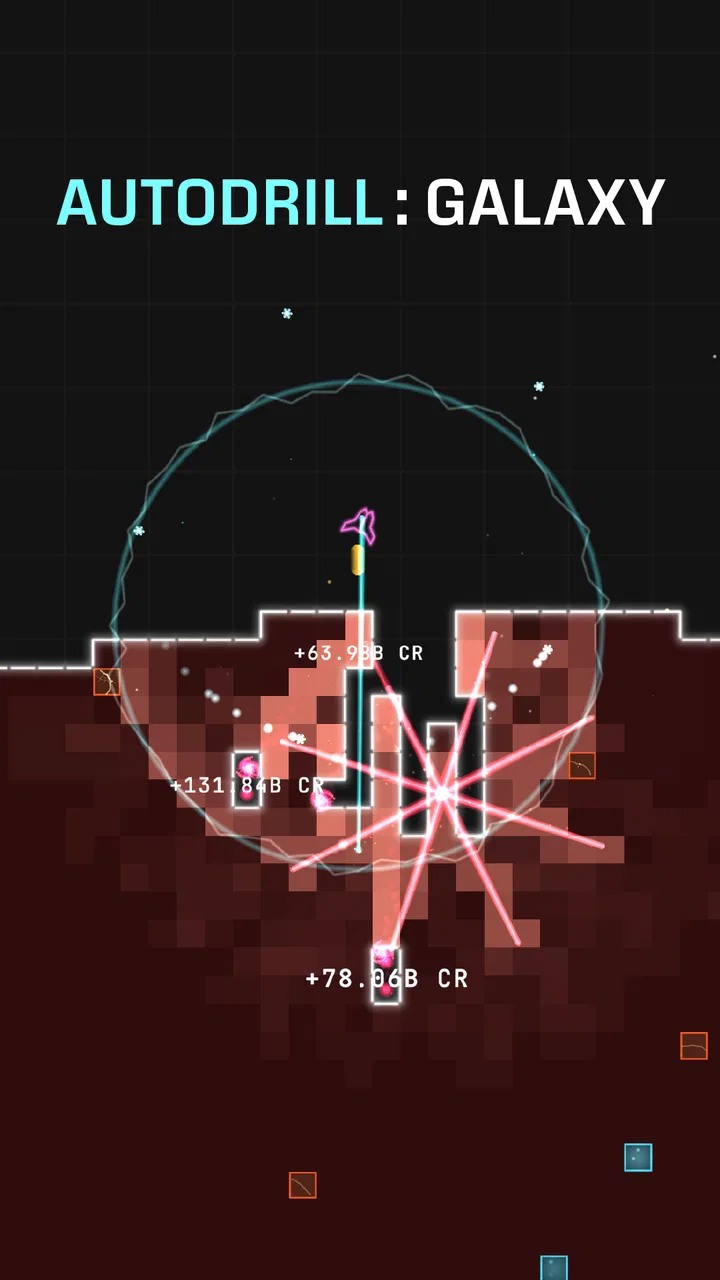
The planetary setting gives that loop a useful sense of direction. Each block is more than a neutral progress bar because the visual language suggests that I am moving through a place, not simply filling an abstract meter. The galaxy theme is familiar, but it fits the drilling premise naturally. A machine breaking into strange worlds is easier to accept as a game fantasy than the same mechanic presented without any setting at all.
My first practical tip is to resist treating every early improvement as equally valuable. In an automatic game, the most visible upgrade is not always the one that changes the run most. I found it more useful to watch where progress begins to slow, then choose an improvement that addresses that bottleneck. If the drill is moving reliably but a special ability is rarely helping, strengthening the skill side may matter more than adding another small boost to basic progress.
Planetary art as a functional language
The art direction works best when it keeps the screen readable. A drilling game needs the player to identify the block field, the active tool, and the important upgrade or skill choices without visual clutter getting in the way. The planetary presentation supports that job by giving the action a consistent identity. I never feel as if the setting is competing with the core loop; it frames the loop.
That coherence matters because automatic mechanics can otherwise become visually empty. When the player is not constantly tapping to perform the main action, the surrounding presentation has to provide some of the energy. The space-and-planet theme gives the repeated destruction of blocks a sense of travel. Even when the underlying action is repetitive, the screen communicates that the run is moving somewhere.
I would not recommend approaching this as a narrative science-fiction adventure. The setting is there to establish mood and purpose, not to replace a story campaign. I enjoyed it more once I stopped waiting for the galaxy to deliver elaborate world-building and instead focused on how the visual theme makes the simple activity feel more deliberate. That is a reasonable trade-off for a compact strategy title, but it should be clear to anyone expecting a rich fictional universe.
There is also a useful visual lesson in the game’s structure: automatic progress is easier to follow when the environment changes the feeling of the run, even if the player’s actions remain familiar. I paid more attention to the route when the planetary presentation made each section feel like another stage of the expedition. That is a small atmospheric strength, but it helps prevent the drill from becoming just a number climbing in the background.
Sound and the pace of short sessions
The game’s mood depends heavily on its rhythm. Drilling naturally creates a repeated cycle, and that cycle can either feel calming or monotonous depending on how the surrounding presentation supports it. In my experience, the best sessions are the ones where I let the automatic action run while I make occasional decisions instead of trying to force constant interaction. The pacing is more comfortable when I treat it as a game of intervals: check the situation, make a choice, watch the result, and return later.
I would describe the atmosphere as closer to a focused background activity than an intense strategy contest. That makes it suitable for a commute, a short break, or the few minutes before going to sleep, provided you are comfortable with a game that does not demand your full attention every second. It is also a good fit for players who enjoy watching a system improve gradually rather than repeatedly failing a difficult challenge.
The trade-off is that the same rhythm can lose its charm during a long uninterrupted session. Because the central action is intentionally automatic, there may be stretches where I am waiting for enough progress to justify the next meaningful decision. I found that switching away and returning later preserved the mood better than trying to extract a lengthy play session from it. This is not a criticism of the design so much as a clear indication of the game’s natural use case.
For that reason, I would not compare its pacing directly with a traditional real-time strategy game. Those games usually reward constant observation, positioning, and rapid responses. Auto Drill is closer to a gradual optimization toy with a planetary skin and a strategy label. It gives me room to think between actions, but it does not offer the same urgency or tactical pressure. Players who prefer deliberate, low-stress progress will probably appreciate that difference; players who want constant decisions may find it too quiet.
Where the mechanics become more interesting
The central mechanical fit comes from combining automatic drilling with upgrade choices and skill fusion. The automatic part removes repetitive manual work, while the strategic layer gives me a reason to keep checking the run. I am not simply watching a drill operate with no input. I am trying to shape the conditions under which it performs better, and that makes the passive movement feel purposeful.
The fusion idea is especially important because it gives the game a planning angle beyond individual upgrades. When skills can be combined, I have to think about whether a short-term improvement is worth using now or whether it is better to preserve resources or opportunities for a more useful combination. That creates one of the game’s better trade-offs: immediate speed feels rewarding, but long-term efficiency may require patience.
A practical workflow helped me avoid wasting choices. At the beginning of a run, I look for the improvement that makes the basic loop more stable. Once the drill is progressing comfortably, I pay closer attention to skills and combinations rather than continuing to select the same kind of boost automatically. This two-stage approach keeps the early game moving while leaving room for more deliberate decisions later.
Another non-obvious strength is that the automatic system makes experimentation less punishing than it would be in a fully manual game. I can try a different improvement path and observe the result without having to perform every action myself. That makes the title approachable for someone who likes strategy but dislikes demanding controls. On the other hand, the reduced control means I cannot rescue every poor decision through quick reactions. If the build is inefficient, the answer is usually to rethink the choices rather than play more aggressively.
The game is free to download, which makes it easy to test the loop without a purchase commitment. It includes in-app purchases ranging from $1.99 to $99.99 per item, so I would advise treating optional spending carefully. The automatic format can make progress feel especially tempting to accelerate, because the player is always watching a system that could move faster. I recommend deciding in advance whether you are happy with the natural pace. If you are, the game is easier to enjoy as a free experience; if you are not, the purchase structure may become a source of pressure.
That is also where it differs from some conventional strategy alternatives. A classic strategy game usually sells depth through maps, units, resources, and direct control. Here, depth is compressed into progression choices and skill combinations. The reward is convenience and a softer learning curve, but the cost is less tactical variety. I would choose Auto Drill for relaxed optimization, not for competitive planning or a large strategic sandbox.
Who will enjoy the loop, and who should skip it
I think it suits players who like incremental improvement but still want a science-fiction frame around it. It works particularly well for someone who wants a game that can be checked in small moments: start the drill, make a meaningful adjustment, and leave once the next decision is clear. The Everyone rating also makes it a broadly accessible choice from a content perspective, although the automatic progression may be more appealing to patient players than to younger players seeking constant direct action.
A realistic everyday scenario would be a short lunch break. I can open the game, inspect whether progress has slowed, combine or select a skill, and let the next section develop while I finish eating. There is no need to memorize a long control scheme, and the session does not depend on reaching a complicated checkpoint before closing the app. That makes it more practical than a strategy game that punishes interruption.
I would skip it if my priority were a story-heavy space game, a competitive ladder, or a strategy title where every second depends on my commands. I would also be cautious if repetitive progression quickly loses its appeal. The planetary presentation adds character, but it does not transform the automatic drilling into a constantly changing tactical experience. Knowing that before installing it is more useful than expecting the game to become something it was never designed to be.
Device compatibility is another straightforward advantage for older phones and tablets, since the minimum requirement is Android 7.0. I still prefer to keep expectations realistic: compatibility does not guarantee that every device will feel equally comfortable, especially during longer sessions. The most suitable setup is one where the screen makes the block field and choices easy to read, because the game’s strategy depends on noticing changes in progress rather than wrestling with controls.
Small decisions that make the experience better
The first tip I would give a new player is to watch the relationship between effort and result instead of chasing the biggest-looking reward. A large improvement that does not solve the current slowdown may be less useful than a smaller choice that keeps the drill moving consistently. Automatic games often hide this lesson because the action continues either way, but the difference becomes visible over several decisions.
Second, use the game’s pacing to your advantage. I found it more enjoyable to check the run at natural pauses than to stare at it continuously. This keeps the drilling from feeling like a waiting room and turns each return into a small planning moment. If I opened the game only when I had a decision to make, the progress felt more rewarding than when I watched every block disappear.
Third, treat skill fusion as a reason to think ahead rather than as a button to press whenever it becomes available. Combining abilities can be more valuable when it supports the direction of the current run. I would rather build a coherent improvement path than collect unrelated boosts that look attractive individually. This is where the game’s strategy is most concentrated, so it deserves more attention than the basic drilling animation.
Finally, keep spending separate from frustration. If a run slows down, I first ask whether my choices created the problem or whether I simply need to give the current setup more time. That habit matters in a free game with optional purchases priced from $1.99 to $99.99 per item. The game is easier to recommend when played as a patient progression experience, not as a race to remove every pause.
The atmosphere verdict
Auto Drill: Galaxy succeeds because its visual theme, planetary premise, and measured rhythm all point in the same direction. The game wants me to feel that I am guiding a persistent expedition rather than commanding a battlefield. The block-breaking action is simple, but the setting gives it a recognizable mood, while the automatic structure makes the experience comfortable to revisit in short sessions.
Its strongest quality is the fit between presentation and mechanics. The galaxy backdrop would feel unnecessary if the game demanded fast tactical control, but here it supports a slower journey through repeated progress. The art keeps the activity readable, the drilling supplies the rhythm, and the upgrade and fusion choices prevent the experience from becoming completely passive. That balance is modest, but it is consistent.
The limitations are just as clear. The game does not offer the broad strategic variety of a traditional strategy title, and its automatic pacing can become repetitive if I play for too long. The purchase range also means I would approach acceleration options with a budget in mind. These are not deal-breakers for the right audience, but they make the recommendation specific rather than universal.
With a 4.1 average and a growing install base above ten thousand, it looks like a small strategy game that has found an audience for its focused idea. I would recommend it to a friend who enjoys relaxed progression, planetary themes, and making occasional optimization decisions without managing a complicated army or map. I would point that friend toward another strategy game if what they really want is direct control, competitive tension, or a substantial campaign.
My final view is simple: this is best enjoyed as a calm drilling routine with light strategic planning. I like the way its atmosphere gives purpose to an otherwise repetitive action, and I appreciate being able to experiment without handling every movement manually. If that combination sounds appealing, the free entry point makes it worth trying. If you need constant interaction, deep world-building, or a more demanding form of strategy, the same qualities that make this game relaxing will probably make it feel limited.
FAQs for Auto Drill: Galaxy
01What is Auto Drill: Galaxy and how does the gameplay work?
Auto Drill: Galaxy is an idle mining and progression game centered on drilling through planets, collecting resources, upgrading equipment, and expanding your operation. Much of the progress can continue automatically, allowing you to earn materials even when you are not actively playing. When you return, you can spend those resources on stronger drills, improved production, and new areas to explore.
02Can I play Auto Drill: Galaxy without an internet connection?
The basic drilling and upgrade systems may be suitable for short offline sessions, but some features can depend on an active internet connection. Advertising rewards, cloud synchronization, updates, promotional content, and in-app purchases commonly require online access. Before downloading, players should check the store listing and test the game on their device, especially if they expect uninterrupted progress while traveling or using mobile data sparingly.
03Is Auto Drill: Galaxy free to download and play?
Auto Drill: Galaxy can generally be downloaded without an upfront purchase, but free access may include optional in-app purchases and advertisements. These purchases can help speed up upgrades, unlock bonuses, or obtain additional resources, while ads may provide extra rewards. You can usually progress without spending money, although advancement may take more time and require patience during later stages.
04Does Auto Drill: Galaxy contain ads or require purchases to progress?
Players should expect advertising and optional purchases to be part of the experience. Ads may appear between activities or be offered in exchange for boosts, extra currency, or temporary bonuses. Purchases are typically designed to accelerate progress rather than make the game completely inaccessible without payment. However, the balance between waiting, watching ads, and spending can become more noticeable as upgrades become more expensive.
05What devices and permissions are needed to run Auto Drill: Galaxy?
Auto Drill: Galaxy requires a compatible Android or iOS device with enough free storage for the installation and future updates. Performance can vary depending on the phone or tablet, particularly when many effects, timers, or background systems are active. The game may request permissions related to notifications, advertising, analytics, or purchases. Review these requests carefully and install the latest official version from a trusted app store.
Pros
- Simple controls make the game easy to pick up and play.
- Mining upgrades create a satisfying sense of progression.
- Short sessions work well for quick breaks or casual play.
- Colorful space-themed visuals give the game a cheerful style.
- Offline play is convenient when you have no internet access.
Cons
- Progress can feel repetitive after extended mining sessions.
- Upgrade costs may make later progression noticeably slower.
- The gameplay offers limited variety beyond drilling and upgrading.
- Frequent ads may interrupt the flow for some players.
- Small screens can make certain interface elements feel cramped.

Auto Drill: Galaxy
Gallery